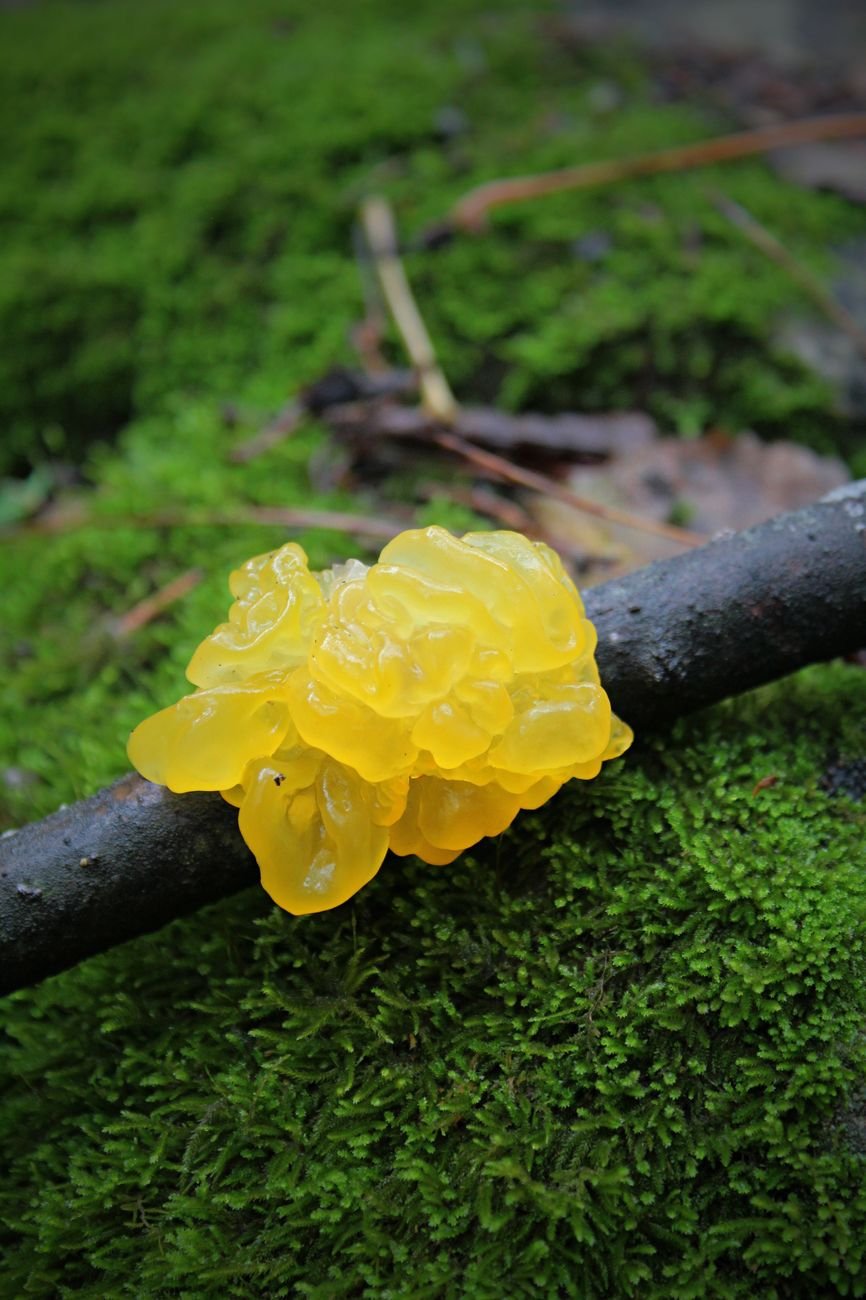
What would you think if you stumbled across this glowing
yellow blob while walking through the woods after a storm?
Would you poke it?
Avoid it?
Assume it came from another planet?
Most people probably see something slimy or gross and instinctually want to burn down the whole forest to be rid of its horror.
I, on the other hand, became unreasonably excited when we found it growing in our front yard for the first time this spring.
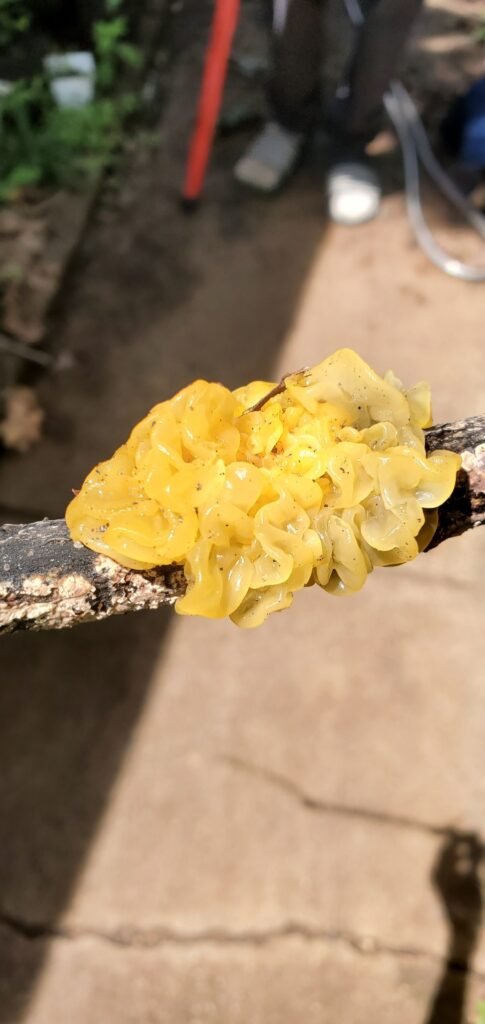
© Jess Reaka, some rights reserved
This strange organism is Witches’ Butter (Tremella mesenterica) … a jelly fungus that appears on dead or decaying wood after rain. Its bright yellow folds look almost artificial, somewhere between sea jelly, alien brain, and melted gummy candy.
Oddly enough… that last comparison isn’t too far off.

© Melisa Smith, some rights reserved
People across parts of Asia have used species within the broader Tremella group for centuries in traditional medicine and cuisine, particularly throughout parts of Asia. Related jelly fungi are commonly used in soups, teas, desserts, and gummy-like sweets because of their naturally gelatinous texture and impressive ability to retain water. Their texture also makes them useful as culinary thickeners.
The “alien forest slime” to “gourmet dessert ingredient” pipeline is apparently very real…
Modern skincare companies have become fascinated with Tremella as well. Certain species produce moisture-retaining polysaccharides so effective that skincare companies now market fungal extracts as vegan alternatives to hyaluronic acid.
Tiny woodland skincare wizard???
Researchers have also explored some related species for their antioxidant, anti-inflammatory, immunomodulating, and moisture-binding properties, helping explain their long-standing role in traditional herbal preparations. Because these fungi retain so much moisture, properly identified jelly fungi have even been discussed as emergency hydration sources in survival situations.
Even cooler… Witches’ Butter can dry out almost completely during drought conditions, shriveling into a thin orange crust that appears dead, only to swell back into bright jelly after the next good rainstorm.
Tiny resurrection blob!!!
The REALLY weird part?
Tremella mesenterica doesn’t simply grow on wood. It parasitizes other fungi already living inside the wood… most commonly crust fungi in the genus Peniophora, particularly Rosy Crust (Peniophora incarnata). Those fungi are already helping decompose dead wood and recycle nutrients back into the ecosystem.
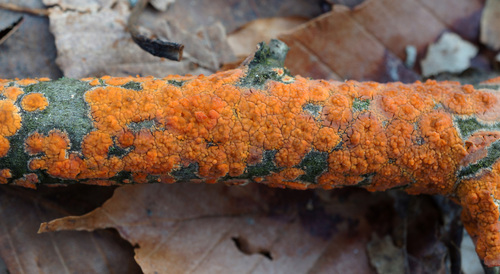
Rosy Crust (Peniphora incarnata), one of the fungi commonly parasitized by Witch’s Butter., © tombigelow on iNaturalist, some rights reserved
So what we’re actually looking at is a fungus feeding on another fungus while both feed on a tree 😄
That strange relationship is part of why fungi are so ecologically fascinating. Forests are not merely collections of trees and animals. They are layered living systems built on countless hidden interactions between decomposers, scavengers, microbes, insects, plants, and fungi quietly recycling life back into the soil.
While Witches’ Butter isn’t considered a classic pollution “canary” quite like lichens are, organisms like this still tell us important things about ecosystem health. Their presence can point toward active decomposer networks, moisture availability, nutrient cycling, deadwood habitat, fungal biodiversity, and functioning woodland microhabitats… which explains why I was so excited to find it thriving here in our front yard.
Lichens monitor the air.
Fungi monitor the breakdown of life itself.
Worldwide, many Indigenous cultures and traditional knowledge systems have long recognized fungi for their ecological, medicinal, culinary, and cultural importance. Unfortunately, colonial researchers historically documented plant medicine far more thoroughly than fungal knowledge, especially in North America.
Honestly… I think we’d all benefit from paying more attention to the strange organisms we’re taught to overlook. Ecosystems are not sustained only by charismatic wildlife and pretty flowers.
They are also held together by slime blobs, scavengers, bacteria, vultures, decomposers, wetlands, worms, and fungi quietly transforming death back into life.
No responses yet